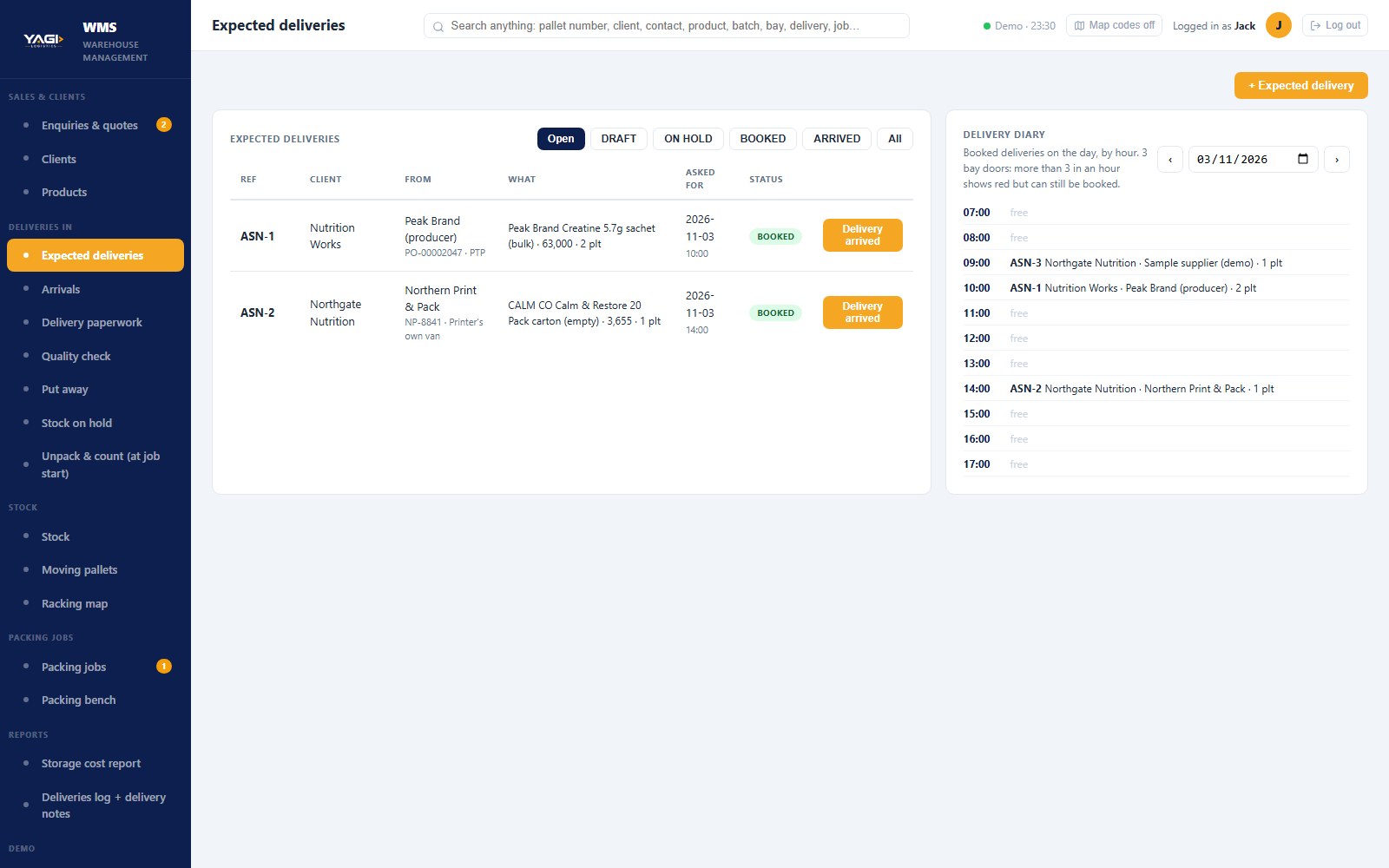
We are Evans Depport Solutions, a software company in Blackpool, Lancashire. Our WMS is live at YAGI Logistics, a Blackpool packing and fulfilment firm, where it runs goods-in, storage, packing jobs and the storage charges their clients are billed for.
What a bespoke WMS does
A warehouse management system is the record of everything that comes in, where it is, what happens to it and what goes out. Done well, it means anyone can find any pallet in seconds, stock counts match the shelves, and every client is billed for exactly what they used.
- Goods-in: expected deliveries, arrivals, delivery paperwork and quality checks, with photos from a phone or tablet
- Reading the delivery note for you: snap the supplier's paperwork and the lines, batches and quantities are filled in
- Put away and a live racking map, so every pallet has a home and a history
- Packing and co-packing jobs: bench set-up, count-as-you-pack and finished pallets labelled for despatch
- Fulfilment: online orders from Shopify, eBay, Amazon or your own shop pulled in automatically, batched into pick lists by the shortest route round the racking, packed, labelled and booked with the carrier
- Returns: booked back in, checked, and either restocked or written off with a reason
- Storage cost reports per client, including free periods, so billing stops being guesswork
- A full audit log: who did what, when, on which pallet
Who it is for
Third-party logistics (3PL) companies, fulfilment houses, co-packers and contract packers, wholesalers and manufacturers with their own warehouse. If you are running stock across several clients, re-packing products under someone else's brand, or charging for storage by the pallet, an off-the-shelf WMS rarely fits. Small warehouses are welcome: the YAGI system started with one client and one product and grew from there.
How we build it
We start with a process map of your warehouse, page by page, in plain words. Each page becomes a screen. We build one process at a time, test it on your floor with your team, then move to the next, so you are using real parts of the system within weeks rather than waiting for a big launch.
It runs in a browser on desktops, tablets and handheld scanners, hosted on Microsoft Azure with daily database backups. Your data stays yours, and you deal with Jason and Melissa directly, not a ticket queue.
What it costs
Every WMS is quoted as a fixed price after a scoping call, and can be spread into monthly instalments so it pays for itself as it goes. We would rather find a way to make it work than have a warehouse stay on spreadsheets because it assumed it could not afford a system.
The technical detail
Built with
- React and TypeScript front end, built with Vite, running in any modern browser
- Separate handheld screens designed for Zebra TC22 Android scanners: big touch targets, scan-first, keyboard only when asked for
- Node.js API on Azure Functions, hosted on Azure Static Web Apps in the UK
- PostgreSQL database (Azure Database for PostgreSQL) holding pallets, stock, jobs, locations and billing
Scanning and labels
- Zebra DataWedge set to send each scan as keystrokes plus Enter, so no app has to be installed on the scanner
- Code 128 barcodes on pallet labels and racking labels, generated by the system and printed on A4
- Pallet numbers per client (for example CL-ABC-00000001), with the supplier's own barcode kept alongside for reference
- Put-away jobs sent to the scanners with a suggested space: the client's part-filled bay first, then their allocated aisle, then the nearest free bay
Data, security and audit
- Version-checked saves, so two people working at once cannot overwrite each other
- Every saved version kept in history, and every change written to an audit log: who, what, when, which pallet
- Microsoft Entra ID single sign-on, so staff use their work Microsoft account with the company's own MFA and Conditional Access
- Read-only database logins for reporting and monitoring, separate from the application login
- Scheduled database backups kept off the server, with restore to any saved version
Testing and releases
- Automated test suite of several hundred checks run before every release
- Changes tested on a local copy first, then committed to Git, then released, with a backup taken before each release
- Releases change code only: live data is never touched by a deployment
Questions people ask
How is a bespoke WMS different from off-the-shelf software?
Off-the-shelf software makes you adopt its process. A bespoke WMS follows yours: your goods-in checks, your packing rules, your billing. You pay for what you use, not per seat for a feature list.
How long does it take to build a warehouse management system?
A full warehouse, packing or fulfilment system usually runs six to twelve weeks. We build it a process at a time, so the first parts are in use well before the end.
Does it work with handheld scanners?
Yes. Screens are built for scanners, phones and tablets as well as desktops, and pallets get printed labels and barcodes.
Can it bill our clients for storage?
Yes. Storage and handling are recorded as they happen and turned into a per-client cost report, including free storage periods after a re-pack.
Do you have a WMS running in a real warehouse?
Yes. Our WMS is live at YAGI Logistics in Blackpool, a packing and fulfilment company, from November 2026.